Chat with us at LMA 2026: Booth 201

CI Belongs to Everyone: Key Takeaways from the LMA 2026 AI Pre-Conference
Michelle Woodyear
Competitive Intelligence Is Not a Department
Takeaways from "CI for the Non-CI Professional: Maximizing Cross-Functional Partnership" at the LMA 2026 Annual Conference Pre-Conference Program, AI, BI, CI: The ABCs of Data and Law Firm Intelligence.
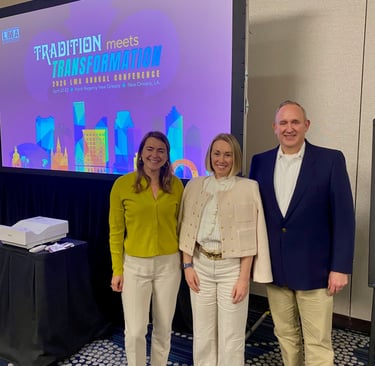
Panelists: Virginia Ryan, Senior Competitive Intelligence Manager, Katten Muchin Rosenman (Moderator); Steve Medley, Senior Market Intelligence Manager, Sidley Austin; and Rachel Cohee, Director of Intelligence Solutions, Holland & Knight.

Five Key Takeaways
1- CI belongs to everyone in the firm, not just the people with "CI" in their title.
Competitive intelligence is a discipline, not a department. Every BD professional, marketing coordinator, and practice group leader uses data to make decisions. The opportunity is to help them do it with more structure, more confidence, and fewer mistakes.
2- The biggest tension in CI is the pull between routine work and strategic analysis.
CI teams spend much of their time on pitch prep, company reports, and meeting briefings. The aspiration is to move toward strategic work like client targeting, lateral recruiting intelligence, and market positioning. AI is starting to create space for that shift by automating the routine.
3- Self-service is the goal, but real barriers stand in the way.
Tool licensing costs keep access centralized. "Closed book" firms restrict internal data visibility. And without data fluency training, self-service can produce bad analysis that's worse than no analysis.
4- An analyst mindset is what separates data delivery from strategic value.
The difference between a researcher and an analyst isn't the tools they use. It's whether they frame the question, assess what data is available, calibrate the effort, do the analysis, tailor the output, and close the loop.
5- Internal firm data is becoming a critical competitive differentiator.
Firms that can organize and leverage their own matter history, client relationships, financial data, and experience records, especially with AI built on top, will have a structural advantage over those that can't.
Meet the Panel
This session brought together three CI leaders who have collectively shaped how the LMA community thinks about competitive intelligence. All three have served as co-chairs of the LMA CI SIG, and they brought perspectives from different firm sizes, structures, and reporting lines.
Virginia Ryan is a Senior Competitive Intelligence Manager at Katten Muchin Rosenman. She designed the session and moderated the panel, with a focus on how CI teams promote self-service across the firm.
Steve Medley is the Senior Market Intelligence Manager at Sidley Austin and the current CI SIG Co-Chair. His focus is on what he calls the "analyst mindset," a structured approach to turning data requests into strategic analysis.
Rachel Cohee is the Director of Intelligence Solutions at Holland & Knight and Co-Chair of the LMA CI SIG. She ran the session's interactive Slido polls and kept the conversation grounded in the realities of firms at every size and maturity level.
The format was a 30-minute foundational talk followed by 45 minutes of hands-on exercises, scenario workshops, and table discussions. What follows are the themes that emerged.
Where CI Sits and Why It Matters
The session opened with Slido polls that confirmed what many in the room already knew: CI functions look different at every firm. Some sit under marketing. Some report into knowledge management. Some have recently moved into newly formed data and AI departments. A significant number of attendees were BD professionals doing their own CI work without a dedicated team behind them.
The panel made the point that where CI reports matters less than how it connects to the rest of the firm. CI sits at the intersection of internal data (financial systems, HR, experience management) and external market intelligence (third-party platforms, news, filings). The value comes from combining those two, and that requires relationships across departments: finance, conflicts, library, IT, and practice group leadership.
One panelist described it simply as sales enablement, even though many people in legal marketing resist that framing. Understanding clients, understanding competitors, identifying where the opportunities are. That's the core work regardless of where it sits on the org chart.
The Self-Service Challenge
Promoting self-service was a central theme. The logic is straightforward: if BD professionals can handle routine lookups themselves, CI teams can move toward more strategic work. In practice, it's complicated.
Tool licensing is one of the biggest barriers. Platforms like PitchBook, S&P Capital IQ, and Foundation use pricing models that make broad access across a large marketing department prohibitively expensive. One panelist noted that they would love to give everyone access to do their own research, but the economics simply don't allow it.
Firm culture adds another layer. At "closed book" firms that restrict visibility into billing data, client lists, or financial performance, even basic self-service hits a wall. CI professionals at these firms described being the sole gateway for information that, at more transparent firms, any BD professional could pull themselves.
And then there's the data fluency gap. Giving someone access to a tool is not the same as giving them the ability to interpret what it returns. The panel discussed how terms like "top client" or "key relationship" mean different things depending on who's asking and what system they're pulling from. One firm is working on building a common data dictionary to get departments aligned on definitions. It's politically tricky, because different teams have legitimate reasons for using the same terms differently, but without that shared vocabulary, self-service produces inconsistent results and CI outputs get questioned.
The panel's practical advice on building self-service was to meet people where they are. Rather than formal training programs that get buried in onboarding, teach in the moment. When a request comes in, use it as an opportunity to show someone how to find the answer themselves next time. Reach out to power users to understand how they're consuming CI outputs. In one case, a team discovered that recipients were summarizing five-page PDF reports down to a few bullet points before forwarding them. If the output doesn't work on a phone screen, it might not get read. That kind of feedback loop reshapes the deliverable itself.
The Analyst Mindset
The panel introduced a framework for approaching CI work that applies whether you have "CI" in your title or not. The core idea: the goal is not to hand over more information. It's to help someone make a better decision, faster, with more confidence.
The framework has six steps. Define and scope the problem: who is this for, what are they trying to accomplish, what would make this useful? Assess whether the right data exists and is accessible: is it tagged correctly, are there licensing constraints, can the question even be answered with what's available? Calibrate depth, time, and effort: a partner lunch briefing is a different ask than a management committee analysis. Analyze, don't just collect: what does the data imply, not just what does it say? Tailor the output to the audience: deck, one-pager, spreadsheet, quick email? And close the loop: follow up, find out what happened, let the feedback inform the next request.
The panel contrasted this with what they called the "researcher mindset," where the work stops at finding information, reporting facts, and delivering what was asked for. The analyst mindset goes further: framing the question, explaining significance, supporting the decision, offering judgment, and following through.
This is aspirational. The daily volume of requests at most firms makes it hard to apply this framework consistently. But the panel noted that AI is making it more feasible. Analysis that would have been too labor-intensive a year or two ago, like estimating a client's total addressable legal spend and mapping the firm's share of it, is now within reach. Requests that CI teams would have declined eighteen months ago are becoming practical. The automation of routine work is what creates the space to think more analytically about the work that remains.
What the Room Surfaced
The interactive portions of the session, including polls, table exercises, and open discussion, surfaced several themes that cut across the panel's formal topics.
The AI verification problem. As more BD professionals use generative AI to pull together company information and client research, CI teams are increasingly being asked to validate AI-generated outputs rather than produce their own reports. Several attendees described a new pattern: someone runs a prompt, gets a plausible-looking company profile, and sends it to CI asking "is this right?" That puts CI in a reactive quality-assurance role and raises questions about how firms should position AI-generated research relative to vetted, subscription-based sources that employ dedicated analysts. The panel acknowledged this is a growing tension, with no clean answer yet.
The routine vs. strategic tug-of-war. Nearly every table discussion touched on the gap between what CI teams want to be doing (strategic analysis, market positioning, lateral recruiting intelligence) and what they spend most of their time on (company reports, pitch prep, meeting briefings). The consensus was not that routine work is unimportant, but that automating and streamlining it is the prerequisite for doing more strategic work. AI is part of that, but so is better process design, clearer data governance, and a firm culture that values intelligence as a function rather than a request queue.
Cross-functional partnership goes both ways. The session pushed the room to think about CI not as a service desk but as a two-way relationship. BD professionals, practice group leaders, and attorneys have context that makes intelligence work better. What happened after the pitch? Did the client mention a competitor? What questions came up that CI could have anticipated? Feeding that information back to CI closes the loop and improves the next round of analysis.
Tool proliferation without tool retirement. Firms accumulate subscriptions over time and rarely sunset old ones. The result is a growing stack of overlapping platforms without clear guidance on which tool is best for which question. Simple reference materials, one-pagers that map common request types to the right tool with real examples, were recommended as a practical way to support self-service without requiring extensive training.
Where This Leaves Things
This session set the foundation for the rest of the pre-conference day. The panel showed what self-service looks like when it works and what gets in the way. They gave the room a framework for thinking more analytically about every request, regardless of title or team size. And they pushed for the structural work, shared data dictionaries, tool guidance, feedback loops, that makes everything else possible.
The through-line: competitive intelligence is not a department. It is a discipline. And the firms that treat it that way, investing in data fluency, building CI-BD partnerships, and creating space for strategic analysis, will be the ones that get the most out of every other technology and AI investment they make.
This post is part of a series from the LMA 2026 Annual Conference Pre-Conference Program, "AI, BI, CI: The ABCs of Data and Law Firm Intelligence," co-chaired by Michelle Woodyear (Mount Insights), Ashley Elliott (FBT Gibbons), and Rafeedah Keys (Perkins Coie). The e-book "The AI-Enabled Legal Marketer" and the guide "Free CI Research Tools" were shared with attendees of the pre-con session.
