Chat with us at LMA 2026: Booth 201

Key Takeaways from the LMA 2026 AI Pre-Conference: Agent-Ready or Invisible
Michelle Woodyear
The AI Shift Law Firms Aren't Ready For (Yet)
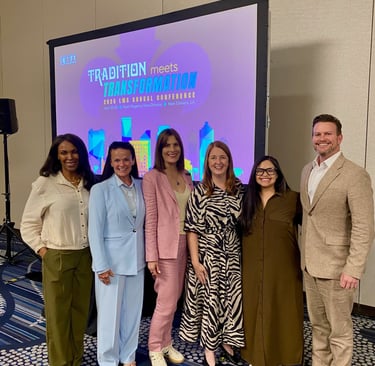
Takeaways from "The AI Marketing Stack: Tools & Prompts for Every Role" at the LMA 2026 Annual Conference Pre-Conference Program, AI, BI, CI: The ABCs of Data and Law Firm Intelligence. Speakers: Greg Gendron (Mount Insights), Nancy Myrland (Myrland Marketing & Social Media), and Rosa Colón (Lowenstein Sandler)

Five Key Takeaways
1-Your firm's first audience is no longer the GC. It's the GC's agent.
As corporate clients adopt AI tools across procurement and legal operations, law firms will increasingly be evaluated by systems before they're evaluated by people. Firms that aren't structured to be understood by machines risk becoming invisible.
2-The capacity conversation is shifting from "time saved" to "revenue unlocked."
Recent survey data shows 55% of major firms are now taking on work they previously would have turned away because they lacked the capacity or resources to scope it. AI is filling that gap.
3-The bottleneck is moving from execution to judgment.
When tasks that took months can be completed in minutes, the question changes from "How long will this take?" to "What should we be doing with the time we just freed up?"
4-Stop thinking in tasks. Start thinking in systems.
The biggest gains come not from isolated AI use, but from identifying repetitive workflows and structuring them so they can be automated, improved, and scaled.
5-Start now, start small, but start.
Every speaker emphasized the same point: the firms that benefit first won't be the ones with the most tools. They'll be the ones that applied tools to real work earliest.
Greg Gendron: Your Firm Is Being Evaluated by Machines
Greg Gendron, COO and AI Practice Lead at Mount Insights, opened the session with a perspective shaped by nearly a decade at Thermo Fisher Scientific, where he saw firsthand what happens when AI becomes operational, not experimental, across an entire enterprise.
At Thermo Fisher, 130,000 employees were effectively augmented overnight. Every marketer gained a research assistant. Every procurement manager could run a pricing analysis instantly. Every in-house lawyer got a tool to summarize contracts and surface risk in seconds.
The critical insight wasn't about the technology. It was about the pattern.
When the buyer's side became AI-empowered, the seller's side had to respond or a capability gap opened. What started as simple automation escalated through intelligence, counter-intelligence, and into what Greg described as agent-to-agent commerce, where systems were negotiating pricing, evaluating terms, and managing supplier relationships at scale. At Thermo Fisher, roughly two-thirds of buying in his division was already machine-to-machine.
Greg's core argument: if procurement can evolve this way, so can a general counsel.
When a GC receives a new matter, the process is increasingly going to look like this: an AI layer reviews historical firm performance, evaluates cost, speed, and outcomes, compares firms across similar matters, and produces a ranked shortlist. The GC still makes the final call. But they're starting from a machine-informed view of the market.
The implication for law firms is significant. As Greg put it, your firm's first audience is no longer the GC. It's the GC's agent. And that agent will know your firm's track record, down to every email delay, billing dispute, and missed commitment, better than your own BD team does.
Greg broke down specific actions by role. BD professionals should read their last proposal the way an AI would, standardize experience data, and build proposal assembly into a system rather than a scramble. Marketing coordinators should recognize that everything they upload is now training data for these systems, and should prioritize structure over style, consistency over cleverness. Marketing leaders should think of their role less as campaign management and more as architecture: deciding what agents should understand about the firm, breaking silos between BD, digital, and content teams, and treating content as a system rather than a publishing calendar.
The firms that don't adapt to this won't necessarily lose opportunities. They simply won't be surfaced.
A deeper dive into Greg's framework for making your firm "agent-readable," including specific steps around discoverability, content structure, and machine-level relevance, will be published separately on the Mount Insights blog.
Nancy Myrland: From Months to Minutes
Nancy Myrland, President of Myrland Marketing & Social Media and 2023 LMA Hall of Fame inductee, shifted the conversation from the macro trend to practical application, grounding everything in real scenarios.
She opened with a data point that reframed the ROI conversation: a recent survey conducted by Ari Kaplan in partnership with Legora found that 55% of major firms surveyed are now taking on work they would have previously turned away due to capacity constraints. The implication is that AI isn't just saving time. It's generating revenue by closing the gap between what firms can do and what they have the bandwidth to pursue.
Nancy's first scenario made this concrete. A client she was working with, a partner focused on healthcare law, wanted to stake out a position across an entire U.S. region. The partner estimated the research and list-building alone would take months. Using iterative prompting in ChatGPT, Nancy produced structured target lists across multiple healthcare segments, including for-profit and non-profit health systems, post-acute care organizations, physician groups, 340B pharmacy organizations, and more, complete with key decision-makers, contact information, LinkedIn URLs, and a content marketing plan aligned to the partner's strategic pillars. What the partner expected would take months was completed in minutes and then layered into a full business development plan.
The work didn't disappear. The friction did. And that freed the partner and her team to focus on strategy, relationships, and execution.
Nancy's second scenario focused on building what she called an internal intelligence resource: a centralized, queryable hub built from a firm's existing content. Bios, practice descriptions, past pitches, strategic plans, blog posts, mission statements. All of it loaded into a tool like Google's NotebookLM, where anyone in the firm can ask questions and get answers drawn from the firm's own knowledge base. Her point was simple: law firms are not short on information. They're short on usable access to it.
The third scenario demonstrated what she called the "360-Degree Strategic Briefing," a multimodal approach to preparing lawyers for a high-stakes pitch. Using the DOJ's antitrust case against Apple as a hypothetical, Nancy walked through how NotebookLM could synthesize a firm's litigation expertise, the DOJ filing, and the company's 10-K to produce a strategic executive pitch summary, a litigation precedent manual, a red-team FAQ anticipating tough questions from the general counsel, an audio briefing for on-the-go consumption, a visual mind map, and even a video overview for visual learners. All from the same set of source materials, adapted to different learning styles.
Nancy closed with her PROMPT Framework (Purpose, Relevance, Options, Model, Polish, True to You) and a set of Monday morning actions, including inventorying high-value content assets, identifying one low-friction workflow to start with, and building a collaborative prompt library across teams. Her overarching message: you are the strategic AI architects in your firms. The bridge between marketing, BD, data, intelligence, and the bottom line.
Rosa Colón: From Tasks to Systems
Rosa Colón, Senior Manager of Marketing Technology and Operations at Lowenstein Sandler, closed the session by bringing everything down to execution level, with an energy and interactive format that got the room on its feet.
She opened by resetting expectations. This wasn't going to be about magic prompts or fully autonomous agents replacing teams. It was about practical, well-scoped workflows that save real time, with guardrails and human oversight built in.
Rosa introduced what she called the "3-Level Ladder" for understanding how AI capability grows in practice. Level 1 is prompting: asking AI to write a client alert summary. Level 2 is automation: when an alert is approved, the system summarizes it, creates email and social copy, and saves it to a campaign folder. Level 3 is the agent: the system reviews matters, identifies the right audience segment, drafts channel-specific copy, flags gaps, requests approval, and pushes to publishing systems.
She paired this with an AI Maturity Model that encouraged attendees to assess where they and their teams fall today, from the assistant phase (summarize, rewrite, extract) through automation, agents, and eventually multi-agent workflows where separate agents handle intake, drafting, QA/compliance, and publishing.
The practical core of Rosa's segment was a set of five agents that teams could start building now. A client alert launch agent that triggers when an alert is approved and drafts website, email, and social copy while suggesting audience segments. A biography freshness agent that scans monthly for stale bios and missing matters or awards. A rankings and directory prep agent that flags upcoming submission deadlines and drafts matter summaries. An event follow-up agent that categorizes contacts from attendee lists and drafts personalized follow-ups by segment. And a competitive intelligence watcher that runs daily or weekly scans, clusters signals by client or practice area, and produces a digest with context on why each item matters and what actions to consider.
Rosa emphasized that the key mindset shift is to stop thinking about individual tasks and start mapping what you do repeatedly. That mapping exercise, which she recommended as a standing weekly activity, is where the real opportunities surface. It's not about finding one big use case. It's about recognizing that the repetitive work you do every day is where automation delivers the most compounding value.
She reinforced this through interactive exercises, including one where attendees became "human agents," working through drag-and-drop workflow design on a live Miro board to solve a real legal BD problem. The goal was to build the muscle memory of thinking in systems, so that when agent capabilities become available at their firms, they're ready to design and deploy them.
Rosa's practical starter formula: pick a narrow trigger, limit your knowledge sources, give the agent only three to five actions, require a human checkpoint before anything publishes, and log every output. She also flagged five risks to watch for: hallucinated facts in matters and credentials, permission leakage where an agent surfaces content a user shouldn't see, tone drift in drafts, workflow overreach where agents act before a human reviews, and garbage-in automation where bad CRM data gets amplified with more speed and confidence.
Where This Leaves Things
This session covered a lot of ground, but the through-line was consistent: the shift isn't about adopting AI tools. It's about organizing your firm, your data, your workflows, and your content so that AI can work with what you already have.
Greg showed where the market is heading and what it means to be evaluated by systems you can't see. Nancy demonstrated what's possible right now with tools that are accessible and affordable. Rosa laid out how to build for it, starting Monday morning.
The firms that move on this won't just be more efficient. They'll be more visible, more relevant, and better positioned at the moment they're being evaluated, by both the humans and the systems advising them.
This post is part of a series from the LMA 2026 Annual Conference Pre-Conference Program, "AI, BI, CI: The ABCs of Data and Law Firm Intelligence," co-chaired by Michelle Woodyear (Mount Insights), Ashley Elliott (FBT Gibbons), and Rafeedah Keys (Perkins Coie). The e-book "The AI-Enabled Legal Marketer" was also revealed during this session.
For more on making your firm agent-readable, visit mountinsights.com.
