Chat with us at LMA 2026: Booth 201


The CRM Landscape Across the Am Law 75
Michelle Woodyear
it is definitely not about the technology...
We've spent the past year assessing digital maturity across law firms ranging from boutiques to Am Law 200 giants. One of the most common conversations we have early in an engagement is about CRM — which platform the firm is on, whether it's working, and whether a change is coming.
we became really curious - what's going on right now?
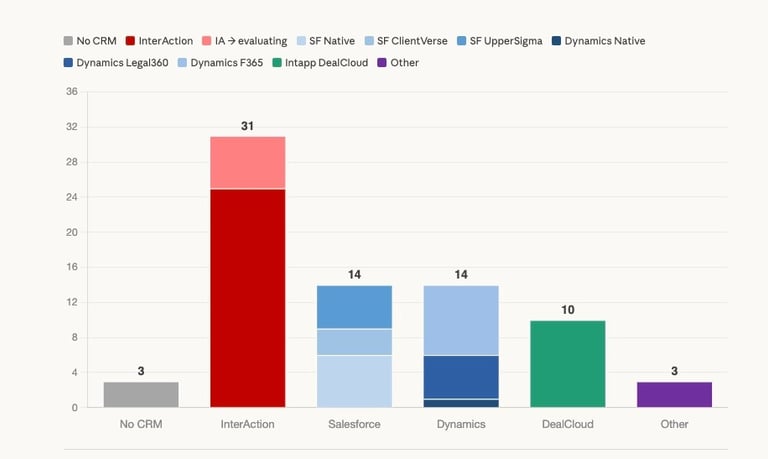
Salesforce and Microsoft Dynamics are gaining serious traction in legal - and it's hard not to see why.
Nearly 40% of the Am Law 75 — 28 firms — have moved to one of the two dominant enterprise CRM platforms. Combined with the 6 InterAction firms actively evaluating a move, that number could reach 34 within the next 12–18 months.
The reason isn't just dissatisfaction with legacy systems. It's that Salesforce and Dynamics offer something purpose-built legal CRMs can't match: a platform that grows with you — built-in AI, deep integrations, massive ecosystems, and a vendor that isn't going anywhere.
But choosing the platform is only the first decision. The more important question is how you build on it.
native vs. legal accelerator: what's the difference?
legal accelerator
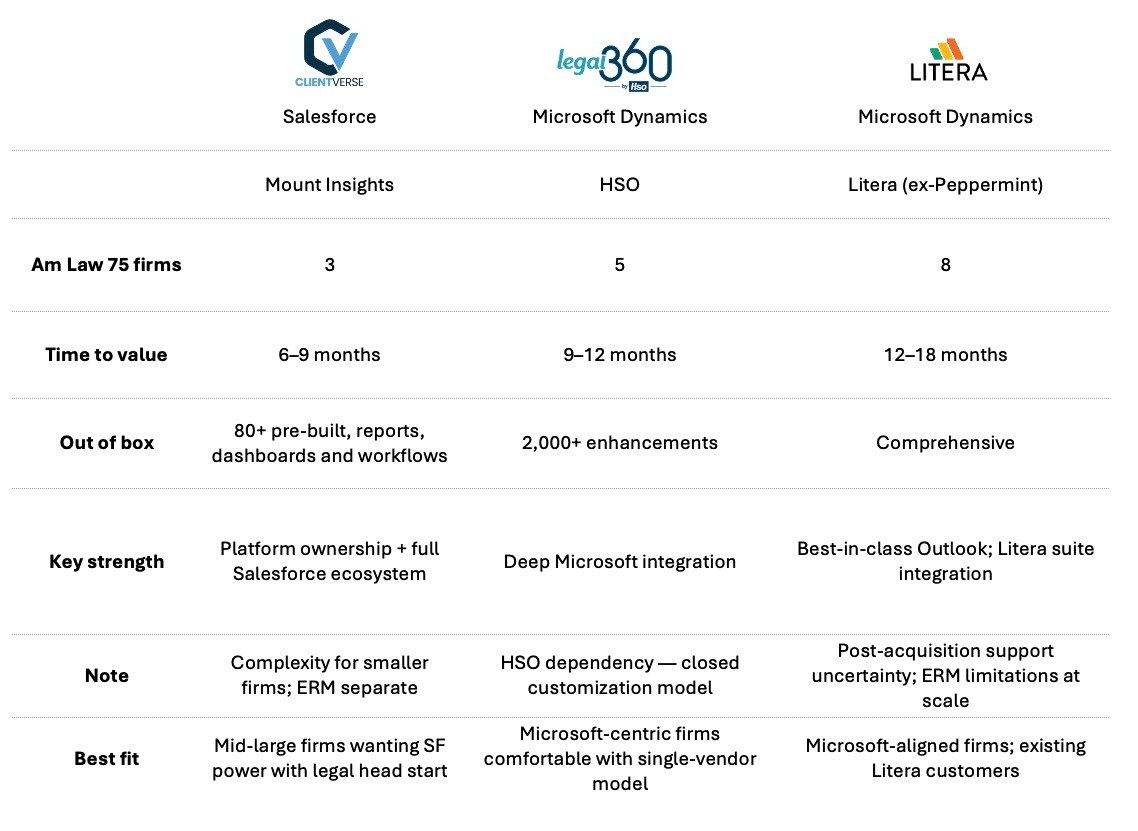
A legal accelerator is a pre-configured layer built on top of Salesforce or Dynamics — arriving with law firm data models, matter relationships, experience tracking, and BD workflows already in place. Firms get to legal functionality faster, with lower implementation risk, while still sitting on an enterprise foundation they own.
native
A native build means starting from scratch on the enterprise platform — maximum flexibility, maximum control, and a system built exactly to your firm's specifications. The tradeoff is real: 9–18 months to value, significant IT resources, and ongoing development costs that don't stop at go-live.
neither path is right for every firm, but for most, the accelerator is the more pragmatic starting point.
it is definitely not about the technology...
We've spent the past year assessing digital maturity across law firms ranging from boutiques to Am Law 200 giants. One of the most common conversations we have early in an engagement is about CRM — which platform the firm is on, whether it's working, and whether a change is coming.
infrastructure gap...
Across the 45+ firms that have completed Mount Insights' Digital Maturity Assessment, we've found a consistent and striking pattern: firms score significantly higher on technology infrastructure than they do on the practices that make that infrastructure valuable. A firm can have a fully deployed, well-integrated CRM and still have no formal opportunity tracking, no pipeline visibility, and no ability to tell a practice group leader which marketing activities produced their last three new clients.
We call this the Infrastructure Gap — and it's the subject of a white paper we're releasing this spring.
The research draws on assessment data across seven dimensions of marketing and business development maturity: technology foundation, digital engagement, client intelligence, experience and proposals, strategic planning, pipeline and growth, and AI readiness. The findings are specific, benchmarked, and — for anyone who has worked inside a law firm marketing department — probably not surprising, but finally quantified.
a few things we'll be sharing
Lead and pipeline management averages just 14% maturity across all firms assessed — the lowest of any category, and the widest gap from where firms say they want to be.
Firms in active technology transitions are exploring CRM, ERM, and GenAI changes simultaneously. The appetite for change is broad, but the sequencing matters enormously.
The firms with the highest overall maturity scores are not the ones with the most tools. They're the ones that have built behavioral practices on top of their infrastructure.
If you work in legal marketing, business development, or firm strategy — or if you advise firms on technology decisions — this is research worth waiting for.
We'll be sharing findings at LMA26 in New Orleans and publishing the full white paper shortly after. If you'd like early access or want to discuss how your firm benchmarks, reach out directly.
